



 6 Min Read


Python Developer + AI Tools: The New Productivity Standard for 2026
In 2026, a Python developer without AI tools is like a pilot refusing to use the cockpit instruments because “I trust my instincts.” Noble.
Also insane. Probably more than one would believe.
The work didn’t get simpler. The tools just got smarter.
Remote Resource sees it daily: teams that combine Python software development with AI copilots, code generators, and smart automation don’t just move faster—they quietly reset what “normal productivity” means.
Let’s talk about how that new standard actually works, without pretending it’s all magic.
The old Python hero vs the 2026 Python stack
Once upon a time, being a great Python developer meant:
- Knowing every library by memory (or at least pretending).
- Writing boilerplate by hand.
- Googling error messages like a second job.
Now:
- AI tools scaffold projects, propose architectures, and write 60–70% of the first draft.
- Linting, tests, and refactors are suggested in real time.
- Documentation and snippets are generated as you build.
The point isn’t to replace humans.
It’s to stop wasting human brains on problems a machine can solve in 0.3 seconds.
Remote Resource treats AI as part of the environment, not a bolt-on gimmick.
Where AI actually helps a Python developer (for real, not in slides)
-
Project scaffolding and boilerplate
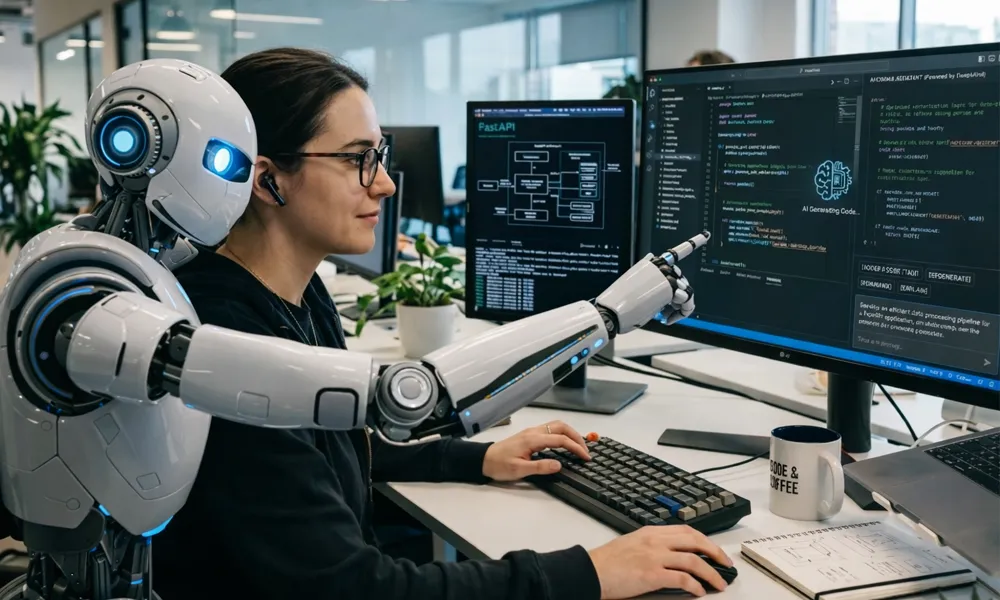
Spinning up a new API, ETL job, or microservice?
In the old world:
- You copy old repos.
- Rename everything.
- Forget a config and spend an afternoon fixing imports.
With AI-aware tooling:
- Describe your stack: “FastAPI service, PostgreSQL, JWT auth, Dockerfile.”
- Get a working skeleton with basic routes, config, and structure.
- Refine and correct instead of starting from a blank folder.
This doesn’t make you less of a Python developer.
It just means you spend more time on business logic instead of wiring boring pieces together.
-
Code generation for the boring but necessary bits
Python software development always has that 30–40% of work nobody wants to do:
- Data validation and schema checks.
- Serialization, deserialization, and pagination.
- Repetitive CRUD endpoints.
AI tools now:
- Turn model definitions into full CRUD routes.
- Generate Pydantic models from JSON samples.
- Draft validation logic and error responses.
You still review and adjust. But instead of 4 hours of typing, it’s 20 minutes of editing.
Remote Resource teams lean into this on purpose: let AI handle repetitive patterns, let humans handle edge cases and design.
-
Debugging and refactoring with an assistant, not a judge
We’ve all stared at a stack trace like it personally insulted our family.
In 2026:
- AI tools read the trace, explain likely causes, and suggest specific code changes.
- They highlight dead code, duplicated logic, and suspicious complexity.
- They propose refactors: “extract this part into a function,” “replace this loop with a list comprehension,” “this can be a generator.”
Good Python software development always involves refactoring.
Now you have something nudging you with “hey, this can be cleaner” all day long.
The ego hit is small. The time savings aren’t.
-
Natural-language queries on your own codebase
The bigger the system, the more time is wasted on “where is this even handled?”
AI code search now allows:
- “Where do we send emails for password reset?”
- “Show me all code that touches the invoices table.”
- “How are user permissions calculated?”
Instead of grepping through 40 files, your Python developer can ask in plain English and jump straight to relevant sections.
Remote Resource uses this heavily on inherited projects, where the original author is long gone, and the doc is… not.
The new collaboration: Python + AI + remote teams
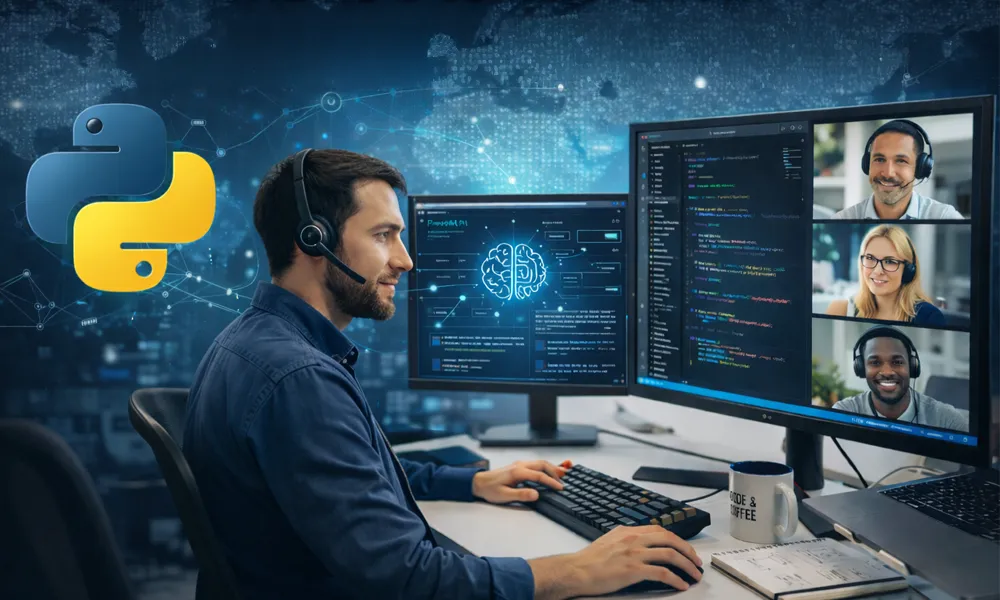
This isn’t just about one super‑powered Python developer in a dark room.
It’s about:
- Remote teams sharing AI-assisted context.
- Standardizing patterns via prompts and templates.
- Using AI as the glue between time zones.
For example:
- Dev A in Europe starts a feature, documents it with AI‑generated summaries.
- Dev B in India picks it up, sees a concise explanation of the approach and tradeoffs.
- Reviews come with AI-suggested comments and test additions.
When you hire Python developers India, and plug them into this toolset, the distance shrinks.
The code speaks for itself more clearly.
Python software development in 2026: the stack that actually makes sense
A modern Python setup, Remote Resource looks like:
- Frameworks: FastAPI / Django / Flask, where it still fits.
- Infra: Docker, containers, CI/CD.
AI layer:
- Copilot-style code assistant in the IDE.
- AI test generator.
- AI documentation and code search.
And, on top of that:
- Linting (black, isort, flake8/ruff).
- Type checking (mypy, Pyright).
- Observability (logs, metrics, traces).
AI doesn’t replace the fundamentals. It cannot.
It just keeps you from spending your life formatting strings and wrestling with forgotten library calls.
Why businesses care: it’s not just “cool dev toys”
All of this matters for one reason: outcomes.
Teams that bake AI into Python software development get:
Faster delivery
- MVPs in weeks instead of months.
- Iterations that take days, not sprints.
Fewer bugs in boring areas
- Validation, mapping, and glue code made more consistent by patterns and suggestions.
Better onboarding
- New hires can query the codebase with natural language.
- They understand systems faster without bugging seniors for tribal knowledge.
Lower long-term costs
- Not because you “need fewer devs,” but because you waste less dev time.
When you hire Python developers in India or anywhere else who already work this way, you’re not paying for extra heroics.
You’re paying for a team that treats AI as part of the craft.
What doesn’t change (and matters more than ever)
AI won’t fix:
- Bad architecture decisions.
- Poor naming and lack of domain understanding.
- “Just ship it” culture with no tests.
A strong Python developer in 2026 still needs:
- Solid understanding of Python internals and performance patterns.
- Awareness of security, privacy, and compliance.
- The ability to say “no, this shortcut will hurt later.”
AI is a multiplier, as you know already.
If the underlying judgment is bad, you just get bad results faster.
That’s why Remote Resource doesn’t just look for “AI‑friendly devs.”
It looks for people who can think in systems and use AI as a power tool, not a crutch.
Why “hire Python developers India” still matters in this story
Now combine:
- Lower relative cost.
- Huge pool of experienced Python devs.
- Comfort with remote teamwork and async communication.
- Familiarity with AI tools baked into daily workflow.
When you hire Python developers India based through a structured partner, you don’t get bargain‑bin juniors.
You get engineers who:
- Have shipped APIs, data pipelines, ML integrations, and automation scripts.
- Are used to collaborating across time zones and platforms.
- Already treat AI‑assisted Python software development as standard, not novelty.
Remote Resource leans on this combination: human skill, Python fluency, and AI tooling all pointed at your backlog.
A quick look at real use cases
Where this combo quietly wins:
Internal tools
- CRM integrations, dashboards, approval workflows.
- Built fast, adjusted often, kept maintainable with AI‑assisted refactors.
Data workflows
- ETL jobs, report generation, model serving.
- AI helps write transformations and tests; humans define logic and quality thresholds.
Automation
- Python scripts that replace manual tasks in ops, finance, marketing.
- AI speeds up script creation, error handling, and documentation so others can reuse them.
AI integrations themselves
- Python is often the glue between your product and external AI APIs.
- Developers use AI to help build AI features—loops within loops, but useful ones.
How Remote Resource treats “Python + AI” as the new baseline
For Remote Resource, this is no longer an experiment.
It’s the standard for how a Python developer should work:
- AI‑assisted coding as a default.
- Code search and doc generation for every non‑trivial project.
- Testing and refactors continuously nudged by smart tools.
- Remote collaboration structured around clear code, not noisy meetings.
You’re not buying “AI hype.”
You’re buying a workflow that’s simply more efficient than pretending it’s still 2016.
A few last words
If your current Python software development feels like wading through mud – slow features, unreadable code, and devs constantly “too busy” to document anything – it might be time to upgrade the way the work is done, not just who does it.
Remote Resource can help you hire Python developers India based who already build with AI at their side…people who treat speed, clarity, and maintainability as a single package, not a trade‑off.
Tell us what you’re trying to ship next. We’ll bring a Python developer (and their AI copilots) who can get you there without turning your codebase into another unsolvable mystery.
Deal?
