


 6 Min Read

Micro-Influencers vs Mega-Influencers: Which Delivers Better ROI?
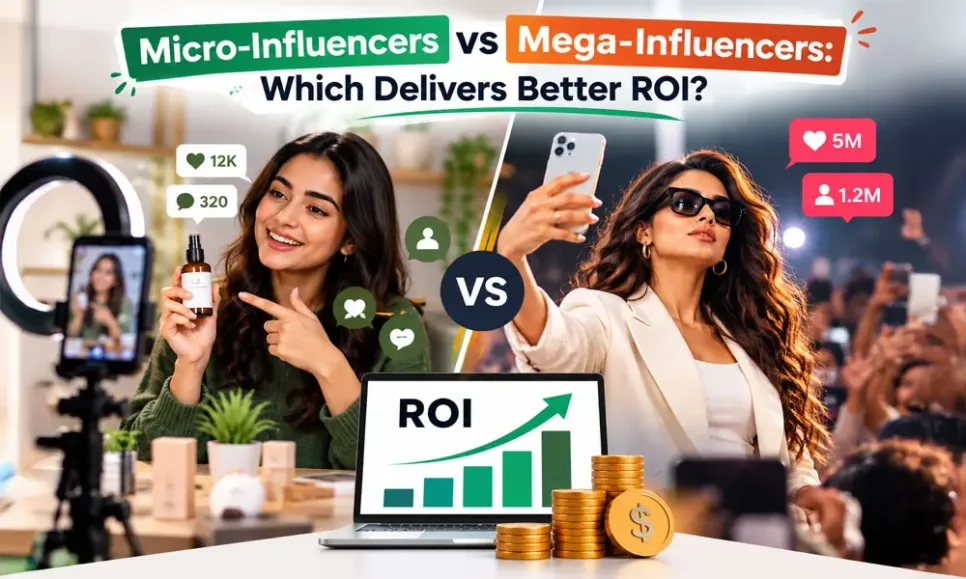
Most brands pick influencers the way they pick billboards — by size.
The logic behind it is simple: bigger audience, bigger impact. Except it doesn’t always work. The mega-influencer posts, you pay the invoice, and you wait for the topline to move. The post collects views and likes. The sales barely budge.
A dreadful situation, isn’t it?
Here’s the thing: reach is not revenue. A mega-influencer can put your product in front of millions — including people who aren’t looking for what you sell. For them, the post is entertainment. They watch, maybe like, and scroll on without ever reaching your landing page.
A micro-influencer works differently. Someone who creates content in your brand’s space puts your product in front of thousands, and many of them are actively looking for a solution like yours. That’s where the revenue comes from.
So which one wins? It depends on what you’re measuring — and most teams are measuring the wrong thing.
That distinction is what makes the comparison below worth reading.
First, Let’s Define the Tiers
Before comparing ROI, get the vocabulary straight. Tier definitions vary slightly by platform and report, but these are the ranges most marketers work with:
- Nano-influencers: under 10K followers — tiny, tight-knit communities
- Micro-influencers: roughly 10K–100K followers — niche authority, loyal audience
- Mid-tier and macro-influencers: roughly 100K–1M followers — broader reach, growing commercial polish
- Mega-influencers: 1M+ followers — celebrity-level reach, celebrity-level pricing
This is not a “small is good, big is bad” debate. It is a question of fit — budget, goal, and audience.
.
Micro vs Mega: Where the ROI Actually Differs
The conversation is more nuanced than a single winner. But on the metrics that touch revenue, the gap is hard to ignore.
1. Cost Per Post
This is the most visible difference — and the one that shapes everything else.
- Micro-influencers often charge somewhere between $100 and $500 per Instagram post
- Mega-influencers commonly start at $5,000 and climb well past $10,000 for a single post
- One mega deal can eat the budget that would have funded ten or twenty micro partnerships
One big bet. Or many smaller ones. That’s the real trade-off.
2. Engagement Quality
Followers are easy to count. Attention is not.
- On Instagram, micro-influencers average roughly 3.86% engagement, compared to about 1.21% for macro-influencers — and under 1% for mega-celebrities
- Smaller creators reply to comments and DMs, so the audience feels heard
- Smaller communities tend to be built around a specific interest, not a general fan base
Fewer eyeballs. More actual conversation.
3. Trust and Authenticity
A recommendation from someone who feels like a peer lands differently than a polished brand deal.
- Micro-influencers usually operate inside niche communities. For example, a micro finfluencer might target middle-aged first-time women investors. Thus, their recommendations feel personal, not transactional
- Mega-influencers stack sponsored posts, and audiences notice — credibility wears thin with every “#ad”
- In one widely cited roundup, 56% of marketers reported better ROI from micro and nano creators than from larger ones
Trust is the hidden multiplier in influencer ROI. You can’t buy it by the million.
4. Reach and Awareness
Here’s where mega-influencers earn their fee.
- Millions of impressions in a single post — nothing micro can match that on its own
- Fast brand awareness for a launch, a rebrand, or a new market entry
- Social proof that comes from sheer visibility
If your goal is to be known, size helps. If your goal is to be bought, that’s a different conversation.
5. Conversion and Cost Per Result
This is the number that decides whether the campaign was worth it.
- Micro campaigns routinely report ROI in the 5×–8× range when executed well, with the occasional outlier going far higher
- Lower cost per post means lower cost per engagement and a lower cost per acquisition — when targeting is tight
- Mega campaigns carry bigger upside on awareness, but conversion per dollar usually trails
So, which one is “better”? Not mega. Not micro. But the one matched to your funnel stage.
When Mega-Influencers Still Make Sense
Let’s be fair. There are real cases where going big is the right call:
- Product launches that need instant, mass visibility
- Brand-building campaigns where impressions matter more than immediate sales
- Broad consumer products with no tight niche — think everyday FMCG, not specialist software
- Brands with deep budgets that can absorb a lower conversion rate in exchange for scale
If that’s you, mega-influencers belong in the plan. Just not as the whole plan.
When Micro-Influencers Win
And the cases where small beats big:
- Niche or specialist offers — B2B services, wellness, SaaS, hobbyist products
- Lean budgets where spreading risk across many creators beats betting on one
- Performance goals — sign-ups, demo bookings, product trials, discount-code redemptions
- Testing phases — try five creators, double down on the two that convert
For most growing brands, this is the zone where influencer spend actually pays back.
The Smarter Play: A Blended Influencer Mix
The sharpest teams don’t choose. They layer.
- Top of funnel: one or two bigger names to build awareness and credibility fast
- Middle of funnel: a bench of micro-influencers to drive consideration and trust
- Bottom of funnel: nano creators, UGC and retargeting to push people toward a purchase
Then measure each layer on its own job. Reach for the top. Engagement for the middle. Cost per lead or sale for the bottom. HubSpot-cited research even points to mid-tier creators as a sweet spot for overall results — a reminder that the answer is rarely at either extreme.
How to Measure Influencer ROI Without Fooling Yourself

A campaign is only as good as its tracking. Before a single post goes live:
- Set one primary goal — awareness, leads, or sales — instead of chasing all three
- Give every creator a unique link, UTM, or discount code so results trace back to a person
- Track cost per engagement, cost per click, cost per lead, and revenue per creator — not just likes
- Compare creators against each other, then cut the bottom performers
- Review after 30 days, not 3 — influencer content has a tail
If the dashboard can’t show revenue, it’s the wrong dashboard.
Where This Usually Breaks for Growing Teams
The logic isn’t hard. Executing it is.
Sourcing creators. Vetting audiences for fake followers. Negotiating rates. Briefing, approving, tracking, reporting, renewing. Multiply that across 15 creators and three platforms, and it becomes a full-time job — usually handed to someone already juggling five other things.
Most founders don’t lack the strategy. They lack the bandwidth.
This is typically the moment teams decide to hire SMM experts rather than stretch a generalist across influencer outreach, content, community, and reporting.
A More Natural Way to Get There
You don’t need to build a full in-house social team on day one. And you definitely don’t want to gamble campaign budgets on a hire who’s learning influencer marketing on your dime.
A seasoned smm expert already knows how to:
- Shortlist creators by audience quality, not follower count
- Negotiate rates and usage rights that protect your margins
- Build briefs creators can actually follow — and that convert
- Set up tracking so every rupee or dollar can be traced to a result
- Scale what works and quietly retire what doesn’t
That’s the difference between running influencer campaigns and managing a pipeline of them.
If you’re ready to hire a social media marketer who has handled influencer programs before, Remote Resource® can introduce you to pre-vetted SMM talent who can start contributing without a long ramp-up. No lengthy recruitment cycle. No guesswork.
Not sure whether your budget should go to micro, mega, or a mix of both? Tell us about your product, your audience, and your target ROI. We’ll help you work out the right shape of the team, and the right hire, to get you there.

Frequently Asked Questions
- For most brands, micro-influencers deliver stronger ROI per dollar — thanks to lower fees, higher engagement, and more trusting audiences. Mega-influencers are better for rapid awareness and big launches. The best results usually come from combining both.
- Most sources place micro-influencers between roughly 10K and 100K followers, though some include creators from 1K upward. Mega-influencers typically start at around 1 million followers.
- Rates vary by platform, niche, and region, but micro-influencers often charge a few hundred dollars per post, while mega-influencers can charge $5,000 to well over $10,000 — and celebrities far more. Always negotiate usage rights and content formats alongside the fee.
- The basic formula is (revenue from the campaign − total campaign cost) ÷ total campaign cost. Total cost should include creator fees, product seeding, agency or management time, and paid amplification. Unique codes and tracked links make the revenue side far more reliable.
- Usually, yes. Smaller budgets stretch further across several creators, risk is spread out, and niche audiences tend to match specialist products better. Start with a small test group, track results, and scale the winners.
- If you're spending hours a week on outreach, negotiation, and reporting without clear revenue attribution, it's often more cost-effective to hire a social media marketer or a dedicated SMM expert. A team like Remote Resource® can match you with vetted talent so you aren't relying on trial-and-error hiring.