


 7 Min Read


How Agencies Use Offshore Teams for White-Label Design

Somewhere, an account manager at a creative agency just promised a complete brand overhaul, three landing pages, and twenty social posts by Friday.
They have one in‑house designer.
This, my friend, is how offshore graphic design services quietly became the spine of half the creative industry while everyone pretended it was “all done in‑house.” Agencies sell the big idea. Offshore teams make the pixels behave. Remote Resource just makes sure the whole circus doesn’t burn down.
Let’s talk about how agencies use offshore teams for white‑label design without telling the client the art department is actually in another time zone.
Why agencies are secretly allergic to hiring more full‑timers
Agencies used to solve problems by throwing people at them.
New client? Hire.
Big campaign? Hire.
Freelancer ghosted?
Panic‑hire!
Then came:
- Feast‑and‑famine project cycles
- Retainers that look big until you see the scope
- Clients who expect Netflix‑level visuals on neighborhood‑restaurant budgets
So now:
- Keeping a giant bench of full‑time graphic designers is expensive.
- Paying premium local talent to resize Instagram posts feels like a crime.
- Letting freelancers vanish mid‑project is… familiar pain.
Enter white‑label offshore graphic design services.
Same work. Less overhead. Fewer existential crises.
What “white-label design” actually means in practice
White‑label = your client sees your logo, your email signature, your smiling face on Zoom.
They do not see:
- The Trello board where you’re briefing a team in another country.
- The Figma file with 12 editors online at 3 AM your time.
- The Slack channel where a designer at Remote Resource is asking, “Is this the final logo or final_final?!”
A graphic design agency that uses white‑label support basically does this:
- Own the client relationship and strategy.
- Handle brand positioning, messaging, and creative direction.
- Hand off production, variations, and volume work to offshore teams.
The client sees:
- Fast delivery.
- Consistent quality.
- “Wow, your team is really responsive.”
They never realize “team” spans three continents.
The three kinds of work agencies quietly send offshore
Let’s be honest: not all design tasks are created equal.
1. Volume production
- Social media batches
- Ad variations (A/B/C/D/E because media buyers are never satisfied)
- Resizing, reformatting, platform‑specific tweaks
This is where offshore graphic design services shine.
You set the brand guidelines. They pump out assets like a well‑behaved factory, not a temperamental artist colony.
2. Template‑based design
- Email templates
- Landing page layouts
- Pitch decks and proposal decks
A graphic design agency defines the base system: grids, typography, components.
Offshore teams use it to build infinite variations without reinventing the wheel every time.
3. “Take this napkin idea and make it not ugly”
- Client sketch in PowerPoint
- Rough wireframes
- Brand concept exploration under direction
Senior creatives at your agency set the concept.
Graphic designers offshore refine, polish, and turn it into something you’re not embarrassed to present.
Why agencies love offshore teams more than they admit
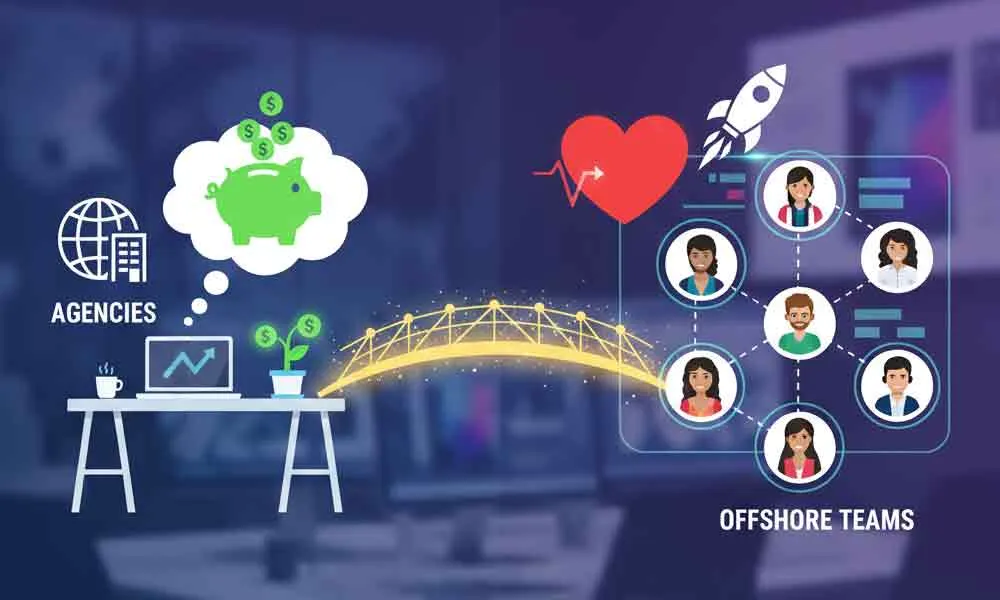
Agencies aren’t sentimental. They’re tired.
Here’s what they get from a good partner like Remote Resource:
- Scalability
- Big project lands? Spin up extra designers without begging HR or LinkedIn.
- Slow season hits? Scale down gracefully. No awkward layoffs.
- Coverage across time zones
- Client sends feedback at 6 PM?
- Offshore team works while you sleep.
- You show up to “done” instead of “we’ll start at 10.”
- Cost efficiency without garbage quality
- Offshore doesn’t mean cheap and bad.It means graphic designers working in economies where their rates don’t give your CFO palpitations.
- Less 0r no burnout
- Your in‑house creatives stop doing 14 versions of the same story post.
- They focus on big ideas, not endless exports.
How white-label design actually works behind the curtain
A decent process (the kind Remote Resource loves) looks like:
- Discovery & brand download
- You share brand kits, previous work, tone, do‑and‑don’t.
- Offshore team builds a “brand brain” from it: reusable styles, components, references.
- Workflow setup
- Choose tools: Figma, Adobe CC, Notion, Slack, whatever your religion is.
- Set request formats: brief templates, asset specs, deadlines.
- Roles & levels
- Senior art director/creative director (your side).
- Mid‑weight & junior graphic designers (offshore side).
- Dedicated account coordinator to keep everything moving.
- Feedback and revisions
- Clear structure: X rounds of revisions, Y response time.
- Loom videos, annotated screenshots, not cryptic “can you make it pop?”
- Reporting
- Weekly or biweekly summaries: volume, turnaround time, bottlenecks.
- You see the machine, not just the outputs.
It’s not magic. It’s a production line wearing a design turtleneck.
The fear: “Will clients notice?”
Short answer: not if you do it right.
Longer answer:
Clients don’t ask, “Where is your graphic design agency physically located?”
They ask:
- “Do you understand my brand?”
- “Can you hit deadlines?”
- “Will this look good on my phone?”
If your offshore setup:
- Respects the brand.
- Delivers fast and consistently.
- Communicates clearly through you.
Then no one cares if the files were pushed at 3 AM from Mumbai or 3 PM from Montreal.
Remote Resource is obsessed with this invisibility.
The goal: your client thinks you hired three new designers.
You quietly know you just onboarded offshore graphic design services that work.
Quality control: the line between help and chaos
Offshore design only fails when you skip guardrails.
You need:
- A well‑documented brand system: colors, type, voice, references.
- A clear set of “never do this” examples.
- A lead designer or art director who approves everything before the client ever sees it.
Think of graphic designers offshore as a band.
Your in‑house creative lead is the conductor.
Without a conductor, you get noise.
With one, you get an orchestra that plays on‑brand, on‑time, and on‑budget.
Real uses that make agencies quietly addicted
A few ways agencies use white‑label teams and never go back:
- Retainer fulfillment
Monthly content packages for clients: 20 posts, 3 reels, 1 newsletter template.
Offshore team handles the grind; internal team handles strategy.
- Pitch season
When every RFP seems due “end of week,” offshore graphic designers turn rough ideas into polished decks overnight.
- Website & landing page sprints
Wireframes from UX → full UI in Figma, with all states and breakpoints, delivered in days not weeks.
- Brand rollout
After a rebrand, there’s a long tail of collateral: brochures, email signatures, ads, slide decks.
Offshore graphic design services chew through this while your senior team works on the next big thing.
The India advantage (even if you don’t say it out loud)
A lot of white‑label work sits in India for boring, practical reasons:
- Huge pool of graphic designers with agency and product experience.
- Familiarity with Western aesthetics, SaaS brands, and e‑commerce patterns.
- English communication that keeps briefs clear and Slack channels civil.
- Time zone offset that turns your “EOD feedback” into next‑morning deliverables.
Remote Resource thrives here: matching agencies with designers who’ve already shipped work for global brands; they just don’t have their name on the door.
What agencies get wrong when they try this alone
The three classic mistakes:
- Treating offshore designers like mind readers
- No real briefs, just “make it better.”
- Result: revisions on revisions on revisions.
- No single source of truth
- Brand guidelines in ten different files.
- Feedback scattered across email, chat, and voice calls.
- No rhythm
- Random asks, inconsistent volume, unclear priorities.
- Designers can’t plan capacity; everyone is always “urgent.”
A structured partner fixes this with:
- One intake process.
- One place where feedback lives.
- A predictable cadence of work.
That’s where Remote Resource stops it from turning into chaos disguised as “outsourcing.”
How Remote Resource fits into this slightly messy picture
Remote Resource doesn’t show up as “the other company.”
We show up as “the extra team your agency magically has now.”
We help you:
- Define what should stay in‑house (strategy, concept) and what can move offshore (production, variations, systems design).
- Build a team of graphic designers that stays with you—so they learn your clients and your style.
- Put process around offshore graphic design services so your projects don’t vanish into email threads.
Your clients still just see your graphic design agency.
They get faster work, more options, and fewer delays.
You get to keep your margin and your creative team’s sanity.
A Few Last Words
If your agency feels like it’s always one designer short, it might not be a hiring problem. It might be a structure problem. Remote Resource can quietly plug in an offshore design pod behind your brand…no fanfare, just consistent work that makes you look bigger, faster, and strangely well‑rested.
Tell us what kind of design work clogs your pipeline.
We’ll bring the people who quietly handle it while you stay in front of the client, looking like you planned it this way all along.
