


 6 Min Read


The Complete On-Page SEO Checklist Every Expert Must Follow in 2026
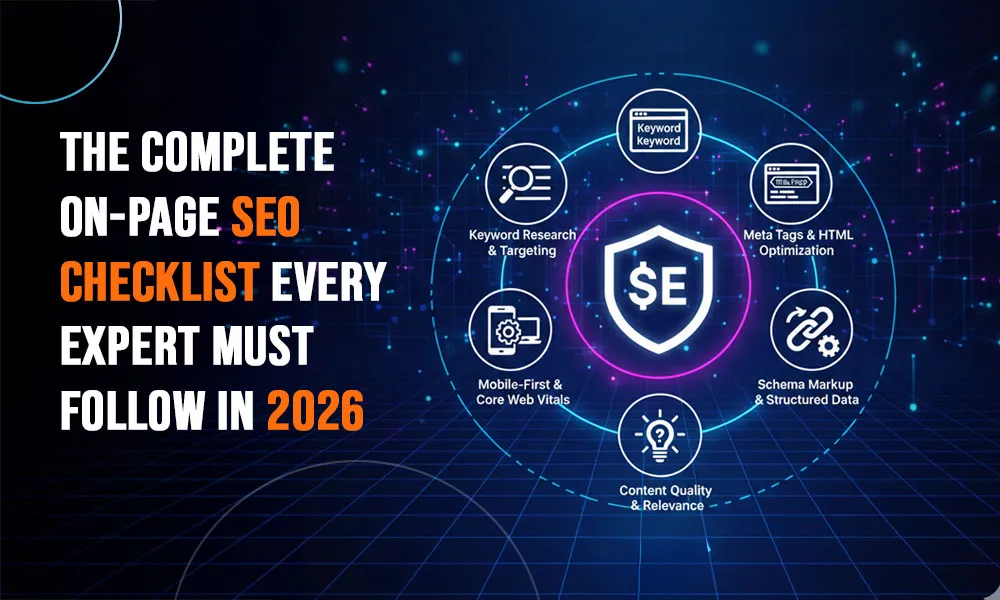
The world of search is changing faster than ever. A few years ago, you just needed keywords and links. In 2026, the game is completely different. Artificial Intelligence (AI) now reads your website, “Agentic AI” browses on behalf of users, and Google’s algorithms have evolved to prioritize human experience above all else. If you are an SEO expert, you know that the old tricks do not work anymore. You must adapt to new rules.
This checklist is your definitive guide for 2026. It covers the new technical files you need, the writing style AI demands, and the essential fixes to keep your site ranking high.
1. Implement the llms.txt Standard
For decades, we used robots.txt to tell search crawlers where not to go. In 2026, there is a new standard you must use: llms.txt.
What is it?
Robots.txt tells crawlers what to ignore. The llms.txt file does the opposite. It is a text file that acts as a “treasure map” for Large Language Models (LLMs) like ChatGPT, Claude, and Google Gemini. It tells AI agents exactly which pages on your site are the most important and how to read them.
Why it matters
AI agents are now 33% of organic traffic. If they can’t easily read your site, they won’t use you as a source. They will cite your competitor instead.
The Checklist Item:
- Create the file: Make a simple Markdown file named llms.txt.
- Curate your content: List your most valuable pages, product documentation, and core service pages. Do not include everything—just the best.
- Upload it: Place it in the root folder of your website (e.g., yourwebsite.com/llms.txt).
2. Master Core Web Vitals: The INP Metric
Google still cares deeply about speed, but the metric has changed. The old “First Input Delay” (FID) is gone. The new standard for 2026 is Interaction to Next Paint (INP).
Why INP Matters
FID only measured the first click. INP measures every click. It checks how fast your site reacts when a user taps a button, opens a menu, or types in a form. If your site lags for even a split second, Google sees it as a bad user experience.
The Checklist Item:
- Test your speed: Use Google PageSpeed Insights to check your INP score.
- The Goal: Your INP score must be under 200 milliseconds for a “Good” rating.
- The Fix: Minimize main-thread work. If you have heavy JavaScript code running ads or pop-ups, it will kill your score. You may need a developer to optimize this.
3. Write for “Agentic AI” (The Answer First)

In 2026, humans are not the only ones reading your blog. AI “agents” search the web to complete tasks for people. They look for direct, factual answers. If your content hides the answer at the bottom of the page, the AI will ignore you.
To win, you must use the “Inverted Pyramid” writing style.
The Checklist Item:
- The Answer: Put the direct answer to the user’s question in the very first paragraph.
- The Context: Explain the details, the “how,” and the “why” in the middle of the post.
- The Data: Put your sources, charts, and deep research at the bottom.
- Formatting: Use short bullet points and clear headings. AI agents love structured lists.
4. Prove Your Experience (E-E-A-T)
Google’s AI looks for E-E-A-T: Experience, Expertise, Authoritativeness, and Trustworthiness. In 2026, Experience is the most critical factor.
AI can write a generic article about “how to fix a sink” or “best hiking boots.” But AI cannot actually fix a sink or hike a mountain. It has no hands. You must prove that a real human being did the task.
The Checklist Item:
- Use “I” and “We”: Write from a personal point of view. Avoid the passive voice.
- Show Evidence: Include original photos or videos of you using the product or doing the service. Do not use stock photos.
- Author Bios: Every post must have a bio. Link it to the author’s LinkedIn profile to prove they are a real SEO expert with a track record.
5. Use Schema Markup for AI Context
Schema markup is code that helps machines understand your content. It turns a boring link into a “rich result” with stars, prices, and images. In 2026, it is also how AI understands who you are.
The Checklist Item:
- FAQ Schema: Mark up your questions and answers. This makes it easy for voice assistants to speak your content.
- Organization Schema: Tell Google exactly who you are, where you are located, and what you sell.
- Profile Page Schema: Use this for your authors. It connects their bio to their other work on the web, building their authority.
-
Upgrade from SEO to SXO
Ranking #1 is no longer enough. If a user clicks your link but leaves immediately because the text is too small or the ads are too big, you lose. This is called “Pogo-sticking,” and it hurts your ranking.
The new goal is Search Experience Optimization (SXO). This combines SEO with User Experience (UX).
The Checklist Item:
- No Pop-ups: Remove intrusive pop-ups that cover the screen on mobile devices.
- Easy Navigation: Users should find what they need in one or two clicks.
- Readability: Keep paragraphs short (2-3 sentences). Use big fonts (at least 16px).
- Accessibility: Ensure your images have Alt Text and your site works for screen readers.
7. When to Hire Search Engine Optimization Services
This checklist is long. It involves coding (llms.txt), technical speed fixes (INP), and a completely new way of writing content. For many business owners, this is simply too much work to do alone.
If you are overwhelmed, it might be time to look for professional search engine optimization services. A good agency can run a deep audit of your site. They have the tools to check your INP score, validate your schema markup, and find technical errors you might miss.
Don’t wait until your traffic drops. If you see a decline, get an audit immediately.
8. The Strategic Advantage: Remote Resource
If you cannot afford a full agency, there is a smart alternative: hiring a remote resource.
Remote Resource offers skilled professionals who work for you but are based in another location. They are often much more affordable than hiring a full-time, in-house employee.
Why use a Remote Resource?
- Cost-Effective: You get high-level skills for a fraction of the cost.
- Specialized: You can hire a remote resource specifically for one task, like fixing your Core Web Vitals or writing your llms.txt file.
- Flexible: They can work on your site while you sleep, speeding up your results.
Summary: Your 2026 Action Plan
The future of search is human-focused but AI-driven. To win, you must prove you are real while speaking the language of machines.
- Tech: Add an llms.txt file to guide AI agents.
- Speed: Fix your INP score (aim for under 200ms).
- Content: Answer the user’s question in the first paragraph.
- Trust: Add real photos and detailed author bios.
- Schema: Use FAQ and Profile Page schema.
- UX: Focus on SXO to keep users on your page.
- Help: Don’t be afraid to use search engine optimization services or a remote resource to handle the heavy lifting.
Follow this list, and your site will not just survive in 2026-it will thrive.
