


 5 Min Read


The Role of Scikit-learn Developers in Healthcare AI Projects
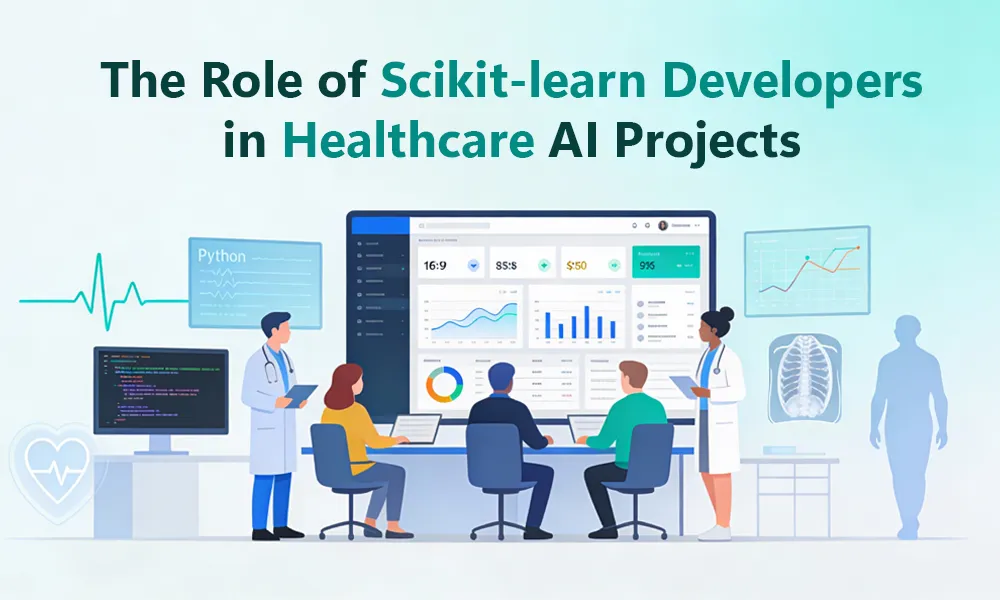
As the medical landscape is being reshaped by generative AI in healthcare industry, machine learning for medical datahas emerged as a crucial driver of innovation in everything, ranging from diagnostics and drug development to hospital operations and personalized medicine.
At the heart of all this is Scikit-learn—a powerful Python library—and every successful delivery of AI projects in healthcare is done by a skilled Scikit-learn developer who understands not just the Python programming language, but also machine learning for medical data ethics, and the overall clinical landscape.
This blog explores the vital role of Scikit-learn developers or Scikit-learn developers, as they are also known as, in AI projects for healthcare and how their expertise fuels transformative, life-saving technologies.
What is Scikit-learn?
Scikit-learn is an open-source machine learning library, that is powerfully capable of performing a wide variety of machine learning tasks using large data sets and algorithms for classification, regression, clustering, dimensionality reduction, and model selection.
These tasks use generative AI in healthcare industry to help diagnose diseases early, predict the recovery times of patients, collect medical data securely for numerous admin tasks like grouping similar patients together, etc. speeding up the process efficiently.
Scikit-learn uses three Python programming language libraries—namely, NumPy, SciPy, and matplotlib—without having to recreate their fundamental mathematical tools, thus saving time and energy.
What makes it particularly useful in AI projects for healthcare is its simplicity, interpretability, and design. For instance, NumPy, SciPy, and matplotlib easily compute advanced data, enabling Scikit-learn developers to easily understand and audit systems, which is essential in regulated industries like healthcare.
Key Roles of Scikit-learn Developers in Healthcare
-
Data Preprocessing and Cleaning
Healthcare data is complex, often incomplete, and messy. Scikit-learn developers are responsible for transforming raw data into usable formats. They apply techniques such as:
- Handling missing values with SimpleImputer
- Encoding categorical variables with OneHotEncoder
- Scaling features with StandardScaler
- Creating pipelines to automate and streamline preprocessing
This step ensures that models are built on accurate, consistent, and reliable data.
-
Model Development and Selection
Scikit-learn provides a wide array of machine learning algorithms, including logistic regression, decision trees, random forests, and support vector machines. Developers select and fine-tune models based on:
- The nature of the problem (classification, regression, etc.)
- Clinical interpretability requirements
- Performance metrics and data distribution
The goal is to build models that are not only accurate but also meaningful and explainable in a clinical context.
-
Model Evaluation and Validation
In healthcare, a model that performs poorly can lead to harmful consequences. Scikit-learn developers use tools like:
- Cross_val_score for robust cross-validation
- Confusion matrices to assess classification performance
- Metrics like ROC-AUC, precision, and recall
They also handle imbalanced data through techniques like SMOTE or class weighting to ensure fair performance across all patient groups.
-
Interpretability and Explainability
Trust is crucial in healthcare. Scikit-learn developers often choose interpretable models and integrate libraries like SHAP and LIME to explain how predictions are made. This transparency is essential for clinicians to understand, validate, and accept AI-assisted recommendations.
-
Integration and Deployment
After developing and validating the model, Scikit-learn developers help deploy it into real-world environments. While Scikit-learn isn’t a deployment tool, its models can be serialized using joblib or pickle and served via APIs built with Flask, FastAPI, or Django. These models are then integrated into hospital systems, dashboards, or mobile applications.
Use Cases of Scikit-learn in Healthcare AI
Scikit-learn developers support a variety of impactful healthcare applications:
- Disease Risk Prediction: The benefits of generative AI in healthcare industry are many—among which perhaps the most groundbreaking is the ability to accurately estimate the likelihood of serious ailments like heart disease, diabetes, or cancer based on patient data.
- Hospital Readmission Prediction: Sci-kit learn developers can use machine learning for medical data like patient characteristics, admission histories and other behavioral data to identifying which patients are at a high risk of returning to the hospital within 30 days, helping hospitals implement targeted follow-up care, while minimizing associated healthcare costs.
- Clinical Decision Support: Sklearn developers can assist in critical clinical decision making by assessing large medical datasets and then suggesting evidence-based recommendations to healthcare providers in choosing diagnostic tests or treatment plans for patients, across a range of clinical situations.
- Patient Segmentation: Hire Sci-kit learn developers to deliver AI projects for healthcare that require effective patient segmentation by yardsticks like risk profiles or treatment responses, which they can do by implementing statistical techniques like clustering and classification.
- Operational Optimization: Last but not least, a mind-blowing innovation of AI/ML is its ability to predict future no-show patients for treatment by using historical records—okay, maybe not that groundbreaking, but sounds amazing for clinics having to face this issue regularly—helping healthcare providers allocate resources efficiently and reducing wait times.
Collaborate with Scikit-learn Developers if You Are
Healthcare Tech Startup Founders
Scikit-learn developers help startups build MVPs quickly with lightweight, interpretable models. They enable fast iteration while meeting compliance requirements—ideal for early-stage ventures with limited resources.
Digital Transformation Officers in Hospitals and Clinics
As hospitals digitize operations, Scikit-learn developers help introduce AI into patient workflows without overwhelming existing systems. They ensure smooth integration with EHRs, predictive dashboards, and internal tools.
CTOs, Technical Leads and Product and AI/ML Hiring Managers
CTOs, tech leads, and AI hiring managers benefit from Scikit-learn’s modular, production-ready tools—enabling fast prototyping, compliance, and scalable AI pipelines with minimal overhead in healthcare applications.
Hire Scikit-learn developers with Remote Resource®
Startup founders in the healthcare AI industry need skilled Scikit-learn developers for clean, interpretable, and compliant machine language models, and Remote Resource® offers you just that by connecting you with India’s top 10% of pre-vetted talent, experienced in end-to-end AI/ML pipelines.
We also offer flexible hiring models—full-time, part-time, or project-based—at offshore rates that reduce costs without sacrificing quality, and our developers understand the ethical and operational complexities of healthcare data.
With a dedicated account manager, time zone alignment, and smooth onboarding, we handle logistics for you so you can focus on core competencies like innovation, building smarter and scaling faster.
Hire healthcare AI developers, Scikit-learn developers or Sklearn developers, and other AI/ML developers with Remote Resource® to power your AI projects for healthcare.
