


 9 Min Read


Why Cross-Device Tracking Matters for Conversion Accuracy
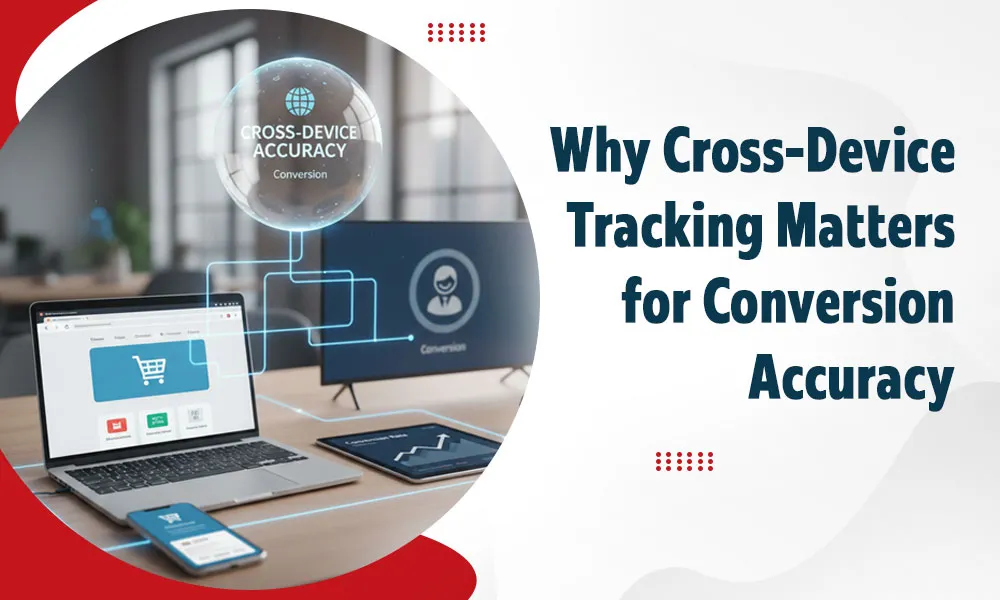
If you are looking at your dashboard right now and thinking you know exactly where your sales are coming from, you are probably wrong. In fact, you might be burning money on ads that look like they aren’t working, while cutting the budget for the campaigns that are actually driving your growth – this is what happens when you don’t have a ga4 expert.
Why? Because human beings are messy. We don’t just sit at a desk and buy things in a straight line. We browse on our phones while waiting for coffee. We research on our tablets while watching TV. Then, three days later, we finally pull out the credit card on our work laptop.
To a standard tracking setup, that one person looks like three different strangers. And that is a disaster for your ROI.
If you don’t have a google analytics expert auditing your setup, you are likely viewing a fragmented reality. You are making expensive decisions based on partial truths.
The Myth of the Straight-Line Customer
We love to imagine the funnel as a neat, orderly slide.
- Customer sees ad.
- Customer clicks link.
- Customer buys product.
It’s a nice story. It makes us feel in control. But it is a fantasy.
The reality is chaotic. The modern customer journey is a zig-zag. It is a series of touchpoints spread across different screens, different locations, and different times of day.
If you treat every device as a new user, your conversion rates will look terrible.
- Your mobile traffic will look like it has a high bounce rate and zero sales.
- Your desktop traffic will look like it converts magically without any marketing support.
You will mistakenly turn off your mobile ads because the data says they don’t work. But in reality, those mobile ads were the introduction. They were the handshake. The desktop was just the closing signature.
Without cross-device tracking, you are firing the salesperson who brings in the leads just because they aren’t the one swiping the credit card.
Also Read: Easy Guide on How Google Analytics Experts Track Website Visitors
What is Cross-Device Tracking?
Cross-device tracking is the technology that connects the dots. It is the ability to recognize that the person on the iPhone in the morning is the same person on the MacBook in the afternoon.
It stitches these sessions together into a single User ID.
Instead of seeing:
- User A (Phone) visited site.
- User B (Tablet) read blog.
- User C (Laptop) bought item.
You see:
User A visited on Phone, then Tablet, then Laptop, and converted.
Suddenly, your data tells a story. Suddenly, you can see the actual path to purchase. This allows you to give credit where credit is due.
Why a Generic Setup Fails You
Most businesses install analytics software out of the box and hope for the best. They trust the default settings.
The default settings are usually blind to cross-device behavior.
Standard analytics relies heavily on cookies. Cookies are stuck in the browser. A cookie on Chrome for Android cannot talk to a cookie on Safari for Desktop. They are islands.
To bridge these islands, you need advanced implementation. You need “User-ID” features enabled. You need Google Signals activated properly. You need server-side tracking to bypass browser restrictions.
This is not something you figure out on a Friday afternoon. This is why smart companies hire a google analytics specialist to build the architecture. If you get the technical implementation wrong, you don’t just get no data—you get bad data. And bad data is worse than no data because it gives you false confidence.
The Role of a GA4 Expert in Solving the Puzzle

The shift to Google Analytics 4 (GA4) was painful for a lot of people. Everyone hated losing Universal Analytics. But there was a reason for the switch.
Universal Analytics was built for a desktop world. GA4 was built for a cross-device world.
GA4 is designed from the ground up to handle this fragmentation. It uses a three-tiered approach to identify users:
- User-ID: Your own internal data (when users log in).
- Google Signals: Google’s massive data set of signed-in users.
- Device ID: The browser cookie (the backup plan).
It cascades through these options to find the best match.
However, enabling this correctly is tricky. It involves privacy thresholds, data retention settings, and connecting your CRM to the analytics layer. A generic marketer will miss these settings. A real ga4 expert knows exactly which levers to pull to maximize visibility without violating privacy laws.
Why Your Attribution Models Are Broken
Let’s talk about money.
If you don’t track across devices, your attribution model is likely “Last Click.”
“Last Click” gives 100% of the credit to the very last thing the user did before buying. Usually, that is a direct visit or a branded search on a desktop.
This makes your SEO and Brand Search look like heroes. It makes your Instagram Ads and YouTube strategy look like failures.
So, what do you do? You cut the social budget.
And then, surprisingly, your hero channels stop performing. Why? Because you cut off the top of the funnel. You stopped feeding the machine.
Cross-device tracking fixes this. It allows you to use data-driven attribution. It shows you the assist.
- It shows that the user saw the YouTube video on their TV.
- It shows they clicked the Instagram ad on their phone.
- It shows they finally Googled you on their laptop.
When you see this, you realize that the Instagram ad did work. It just took time to pay off.
This insight changes how you spend your budget. It stops you from cutting the channels that are actually driving your growth.
The Privacy Elephant in the Room
We cannot talk about tracking without talking about privacy.
Users are becoming more protective of their data. Browsers like Safari and Firefox are blocking third-party cookies by default. Regulations like GDPR and CCPA are tightening the screws.
This makes cross-device tracking harder. You can’t just follow people around the internet like a stalker anymore.
You need to do it ethically, and you need to do it legally.
This usually means relying on first-party data. It means encouraging users to log in to your site so you can assign them a secure User-ID. It means obtaining proper consent.
A google analytics specialist is not just a data nerd; they are a compliance officer. They ensure that your tracking setup respects the user’s choices while still giving you the business intelligence you need. If you try to hack this together yourself, you risk fines and reputation damage.
The Google Analytics Expert Advantage
The holy grail of cross-device accuracy is the login.
If you have a business where users log in (an ecommerce store, a SaaS platform, a membership site), you are sitting on a goldmine.
When a user logs in, you know exactly who they are. It doesn’t matter what device they are on. It doesn’t matter if they cleared their cookies. The User-ID is the source of truth.
But here is the catch: You have to push that User-ID into GA4 securely.
You need to configure the code to grab that ID from your database and send it to Google every time a session starts.
This requires developer skills. It requires testing. If you send the wrong data (like an email address or a name) to Google Analytics, Google will ban your account. They have a strict No PII (Personally Identifiable Information) policy.
A ga4 expert knows how to hash these IDs. They know how to send the unique identifier without sending the personal details. They keep your account safe while making your data rich.
When Cross-Device Tracking is Critical
Do you really need this? Or is it just for Amazon and Netflix? If you fit any of these profiles, this is non-negotiable.
1. High-Ticket Items
If you sell expensive things (consulting, luxury goods, enterprise software), people do not buy on impulse. They research. They take weeks. They switch devices constantly. If you don’t track across devices, you have zero clue how you got that sale.
2. B2B Companies
B2B buyers are notorious device switchers. They check email on their phone during the commute, browse your site on their iPad at lunch, and fill out the contact us form on their work PC. A google analytics expert can map this journey so your sales team knows exactly what content the prospect consumed before calling.
3. Omni-channel Retailers
If you have a physical store and an online store, it gets even crazier. Users might check prices on their phone while standing in your store. Advanced setups can even bridge the offline-online gap, but that requires serious architectural work.
The Hidden Cost of “Good Enough” Analytics
Many business owners think, “I can see the total sales in Shopify/Stripe, so why do I need detailed analytics?”
Because totals tell you what happened, not why.
If sales drop next month, and you don’t have cross-device visibility, you won’t know why.
- Did your mobile site break?
- Did your top-of-funnel ads stop working?
- Did a specific device type stop converting?
You will be guessing. And guessing is expensive.
Investing in a google analytics specialist is an insurance policy against ignorance. It gives you the diagnostic tools to fix problems fast.
Why You Shouldn’t DIY Your Data Layer
There is a trend of marketing generalists trying to do everything. They write the copy, run the ads, and try to set up the tracking code.
That is a mistake.
Google Analytics 4 is complex. The Data Layer (the code that talks to the analytics) is complex.
If you mess it up, you get:
- Double counting conversions (inflation).
- Missing transactions (deflation).
- Sessions breaking in the middle (fragmentation).
You end up with a dashboard that lies to you. You make decisions based on those lies, and you lose money.
You need a specialist. Someone who lives and breathes tag management. Someone who knows the difference between a view_item event and a select_content event.
The Remote Resource Approach to Data Talent
So, how do you find this person?
You have three bad options:
- Hire a full-time employee: You will pay $120k+ for a senior analyst. Do you really need them 40 hours a week forever? Probably not.
- Hire an agency: They will charge you a massive retainer, and you will get assigned to their junior intern who barely knows more than you do.
- Hire a freelancer: You might get lucky, or you might get a ghost. You have no way to vet their code until it breaks.
This is why we built Remote Resource
We believe there is a better way. You need high-level expertise, but you need it to be flexible and vetted.
We connect you with a dedicated ga4 expert who becomes part of your team.
- They aren’t an agency outsider; they work on your Slack.
- They aren’t a generic freelancer; they are top 10% global talent that we have rigorously tested.
- They cost a fraction of a US-based full-time hire.
You get the architectural brain of a senior engineer without the bloated overhead.
Conversion Accuracy = Business Confidence
At the end of the day, accurate data gives you confidence.
When you know—really know—that for every $1 you put into Facebook Mobile Ads, you get $4 back in Desktop Sales, you can scale. You can spend aggressively. You can dominate your market.
Without that confidence, you are always hesitating. You are always playing small because you are afraid the ad spend is wasted.
Cross-device tracking removes the fear. It turns the lights on in a dark room.
It’s Time to Stop Guessing
The internet is not getting simpler. It is getting more fragmented. New devices, new browsers, and new privacy laws are launching every year.
If your analytics strategy is set it and forget it, you are falling behind.
You need to align your technology with user behavior. You need to track the human, not the device.
Don’t let bad data dictate your strategy. Fix the foundation. Bring in a google analytics expert who understands the mechanics of the modern web.
Your customers are everywhere. Your tracking should be too.
Ready to finally trust your data?
Stop making decisions in the dark. At Remote Resource, we deploy pre-vetted, elite analytics talent to your team in as little as 48 hours.
