


Somewhere right now, a real estate agent is staring at their phone like it’s personally betrayed them. Open house leads piling up, paperwork deadlines blinking red, social media demanding fresh posts, and that one client who emails Zillow (of all things!) screenshots at 10 pm asking why their house is “only” valued at $47,000.
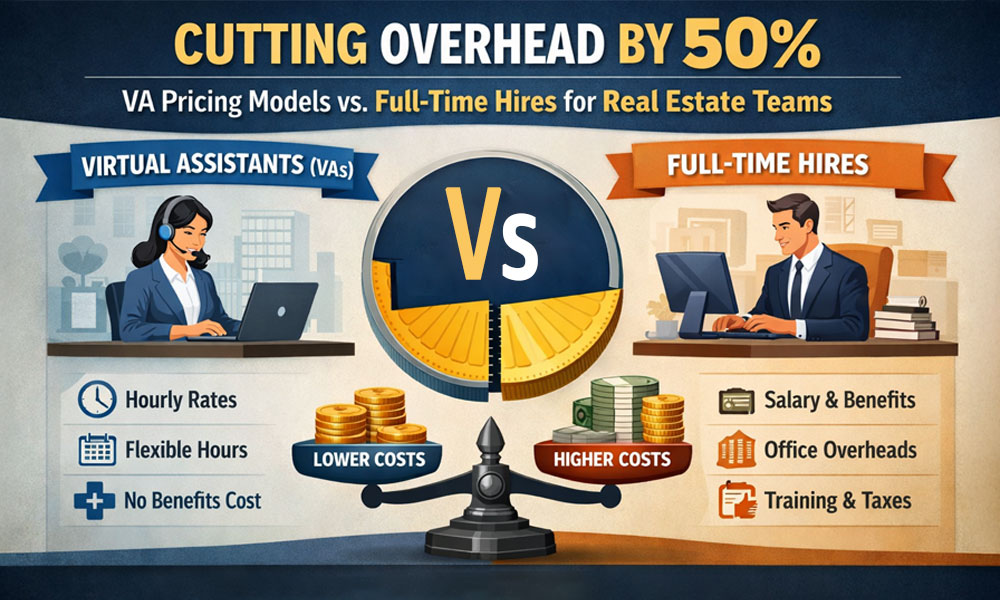
They think, “I need help.” Then the math hits: full-time hire means salary, desk, software licenses, training, taxes, benefits. The calculator starts smoking.
That’s when real estate virtual assistant services show up, not as some fancy replacement for the agent but as the quiet scalpel that slices overhead costs. Remote Resource sees it every day: teams cutting expenses by half or more – by swapping fixed hires for flexible VAs. Here’s how the ledger shakes out, no fluff, just the ugly truth.
Full-Time Hire: The Comfortable Money Pit
The fantasy goes like this: hire a coordinator, they handle everything, agents close more deals, everyone wins. Reality whispers something different.
Base salary starts at $45k-$65k for someone who won’t quit in six months. Add benefits: health insurance alone runs $6k+, plus 401k match, paid time off, payroll taxes at 7.65%. You’re looking at 25-30% on top of base before day one.
Onboarding? Three to six months of ramp-up. Someone’s salary is burning while they learn MLS access, your CRM, local market quirks, and compliance rules. Workspace eats another $5k-$10k—desk, phone line, software seats, maybe parking if you’re old-school.
Worst part: idle capacity. Real estate isn’t 9-5. You pay for 40 hours when they’re useful, 25. Suddenly, you’re inventing tasks or watching quiet Tuesdays tick by at full rate.
Total first-year cost? $75k-$100k. And that’s before they leave for a brokerage with better commissions.
VA Pricing: Pay for Work, Not Warm Bodies

Real estate virtual assistant services flip that equation entirely. Remote Resource builds models around outcomes, not presence.
Hourly runs $12-$25. Lead nurturing? Listing input? Social scheduling? Twenty hours a week equals $12k-$26k yearly. Retainer packages feel even cleaner—$800-$2k flat per month for “inbox + transaction docs + weekly reports.” Predictable. No overtime shocks.
Tiered options make sense too: basic admin at $1k/month, mid-level with social and light marketing at $2k, pro packages pushing $3k+ for full pipeline support. Offshore talent through Remote Resource drops that further—Philippines or India VAs deliver senior work at $8k-$15k annually, same skills, 40-60% less cost.
Total spend lands $10k-$36k. Half (or better) than full-time. Scale up for listing season, dial back in winter. No guilt.
Head-to-Head: The Math That Doesn’t Lie
Full-time coordinator chews $85k Year One: $55k salary, $15k benefits/taxes, $7k workspace, $8k recruiting. VA model through Remote Resource? $19.5k. That’s 77% savings on paper, real numbers from teams who’ve made the switch.
What do VAs actually do to justify that gap? Smart real estate teams don’t treat them as “just admin.” They weaponize them.
Lead routing becomes automatic-Zillow inquiries hit text/email/CRM within five minutes, boosting conversions 30%. Transaction coordination handles DocuSign rounds, compliance checks, and lender ping-pong, freeing 15 agent hours weekly. Market research pulls comps, pricing trends, “is this overpriced?” reports without eating listing time. Content engine cranks Instagram Reels, Facebook posts, newsletters—consistent brand voice without stealing from closings. Open house prep? Flyers, sign-ins, buyer follow-ups on autopilot.
One VA often equals 2-3 extra deals closed yearly. Their cost becomes one commission check.
Seven Hidden Costs Full-Time Hires Drag In (VAs Skip)
Full-time traps sneak up slowly. Ninety days of “learning the ropes” at full pay. Scope creep turns coordinators into undefined “help” for everything. Emotional overhead… performance reviews, tough conversations, inevitable replacement cycles. Tech bloat with individual licenses everywhere. Presenteeism tax: bodies paid for seats, not outcomes. Exit burn when knowledge walks out. Opportunity cost is tying up capital in payroll instead of marketing or acquisitions.
VAs dodge all that. Week One contribution through Remote Resource pre-screening. Laser focus: no “other duties.” Exit means swapping talent, not rebuilding processes.
Risks Exist. Here’s the Guardrails.
Full-time risk: wrong hire sinks the year. No undo. VA risks feel manageable—communication gaps fixed with daily Slack standups and weekly Zooms. Time zone friction? Philippines overlaps US mornings, async tools cover the rest. Quality variance? Remote Resource vetting plus two-week trials limit exposure to $500 max.
Start small: 20 hours weekly. Test chemistry. Scale when it clicks.
Real Teams, Real Results

Philly brokerage, eight agents. Before: two full-time coordinators at $140k overhead. After: three Remote Resource VAs at $42k total. Agent productivity jumped 28%. Same output, 70% cheaper.
Austin investor group: VA handling comps and docs for $1,800/month. Freed 12 partner hours weekly for deals. Four extra flips, Year One = $180k profit.
Your math: hours needed times VA rate versus wasted agent time times their hourly value. Pencil it out.
When Full-Time Still Wins (Be Honest)
Fifty-plus transactions monthly? VA volume caps hit. Complex compliance in luxury or commercial? Local regs matter. Culture carrier under ten people? Presence counts.
Ninety percent of teams don’t need that scale yet. VA fits $2M-$15M revenue perfectly.
2026 Trends in Real Estate Virtual Assistant Services: What’s Coming Down the Wire
Real estate virtual assistant services aren’t standing still in 2026—they’re sprinting toward weird, wonderful territory. Forget the old “email monkey” stereotype. Remote Resource sees teams asking for VAs who can do things we barely dreamed of five years ago.
AI‑Powered Everything. VAs aren’t just using AI; they’re wielding it like a sixth sense. Comps pulled in seconds from MLS + public records + Zillow whispers. Predictive pricing models that flag “this house will sit unless you drop 3%.” Automated lead scoring that texts agents exactly when to call, not just “new lead alert.” Your VA becomes half‑human, half‑oracle.
Video and Social Domination. TikTok Reels of “staged before/afters,” drone footage edits, and Instagram Lives scheduled around peak buyer hours. VAs who can cut a 15‑second listing tour that gets 10k views aren’t “nice to have”—they’re commission printers.
Transaction‑On‑Autopilot. Smart VAs run DocuSign ping‑pong, flag compliance red flags, and even chase title delays before agents notice-some handle wire instructions and closing checklists end‑to‑end. Agents literally show up to sign.
Micro‑Specialization. Need a VA who lives for luxury buyer psychographics? Investor flip comps? Commercial lease abstracts? Remote Resource niches down—your VA isn’t “general real estate”; they’re your unfair advantage in one specific battle.
24/7 Global Handoff. Philippines morning team → Latin America afternoon → Eastern Europe night. Listings never sleep. Leads never cool. Your CRM hums while you dream.
The trend? VAs evolve from “support” to “force multiplier.” In 2026, the team with the best virtual assistant closes first. Simple as that. Remote Resource stays ahead of this curve…they’re already staffing the future.
The Bottom Line
Full-time hires feel comfortable, like overeating at Thanksgiving. Predictable. Expensive. Real estate virtual assistant services feel like rocket fuel: cheaper, flexible, outcome-driven.
Agent closes two extra deals with an empty inbox? Worth every cent. Brokerage pays half for the same output? Laughing to bank.
Overhead isn’t destiny. It’s a choice. Remote Resource makes the smart choice dead simple.
Ready to cut costs without cutting corners? Remote Resource matches real estate VAs to your team. Trial one this month. Watch the math work better than ever before..
